
Breed Analysis for Dogs
With generatio's Breed Analysis for Dogs, you can uncover which breeds and breed groups have shaped your dog's genetic makeup – and which specific breed your dog most closely resembles. You'll gain valuable insights to understand your dog's appearance and behavior better.
Unique Aspects of Dog Breeds
Unlike horse breeding, dog breeding has focused on purebreeding within closed studbooks since the 19th century. Crossbreeding with other breeds is largely excluded. As a result, genetically distinct populations have emerged. A genome-wide study (Parker et al., 2017) found that 146 of 161 breeds examined (91 %) each form their own genetic cluster. These "distinct breeds" have a characteristic genetic makeup, which is why a breed analysis can identify them particularly reliably.
However, dog breeds did not develop independently of one another. Many trace back to shared founding populations or to deliberate crosses between existing breeds. At the genome level, they can therefore be grouped into breed groups, such as retrievers, herding dogs, sighthounds, terriers or mastiff-type dogs. What matters is demonstrable shared ancestry, not appearance, use or legal classification. For this reason, terms such as "fighting dogs" do not constitute a genetic breed group.
Mixed-breed dogs, in which contributions from distinct breeds or breed groups can be detected, must be distinguished from so-called village dogs. Village dogs come from regional, free-breeding dog populations that existed before or independently of modern purebred dog breeding. Their genetic makeup often reflects their geographic origin, for example in Africa, India, or Southwest and East Asia.
To account for these particularities, the breed analysis considers distinct individual breeds, breed groups and regional village dog populations.

Example: Determining the breed composition of ‘Atti’ – according to the owner’s initial information, an F1 Labradoodle (offspring of a cross between a poodle and a Labrador Retriever)
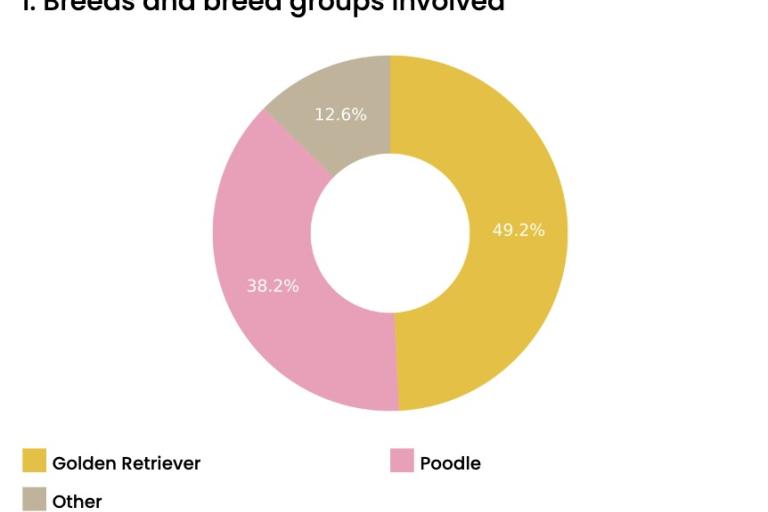
The breed analysis shows that Atti is genetically a ‘Goldendoodle’, i.e. a descendant of a cross between a Golden Retriever and a Poodle. Based on the breed percentages, it is clear that he is indeed a genuine F1 hybrid.